Banking on Enterprise 2.0 to Deliver…

Week 10 and we’re on the home straight! This was obviously by far the broadest stimulus so far, and possible one of the trickiest. We have covered the potential use of blogging and wiki’s as well as the intergration of social networking into enterprise, but what about all of them working together? Some organisations have developed intranet based information guides to try to cover all of the FAQ’s raised by staff but these can often become outdated. Raising a question outside the scope of these guides often means asking your boss, who may not know, then they have to ask someone else, and then you have a game of chinese whispers.

The company that I decided to base this discussion around is the infamous ANZ bank. I chose this for two reasons, the first is my partner has worked for them for three years, and secondly for a company employing very advanced technologies they are lacking here. ANZ has a number of conventional enterprise systems that perform their day-to-day tasks, however I will be focussing on the retail or in branch side. Their main system is Oracles CRM (Customer Relationship management) SIEBEL. This looks after the majority of their retail level tasks including the opening and maintaining of customer accounts, conflict resolution and general inquiries. Coupled with another one of Oracles products, Peoplesoft, that handles all of ANZ’s internal financial and payroll duties ANZ has a well packaged off the shelf enterprise system.

But what about the people who are using this system? It can often be frustrating trying to learn a new system (ESPECIALLY SAP), and when a user is asked to perform a task outside their normal duties it can become disconcerting. As i said earlier ANZ has a fairly comprehensive intranet information guide in place but this is like reading an instruction manual to a space ship. People generally respond better to information written in their language with a degree of personality. This is where a corporate wiki can become useful with information to supplement the intranet. If there was a tool within the information pages that gives staff the opportunity to comment on or amend sections, or simply leave a helpful hint, it would personalise the whole process. It reassuring to know that someone else has been there before you and experienced the same issue.

The retail environment of a branch is a very sales oriented area as it is the ground level of the organisation. Every person that walks through those doors potentially has money to invest, or their existing cash could be better organised. Sitting on some money? How about a term deposit? Wanting to save for that holiday? How about a high interest savings account? Now all of this is taught to the personal bankers and they are expected to sell sell sell to every person they encounter, but other than water cooler conversation how can they exchange their experiences? An online wiki or blogging tool where each employee can read what is working in different branches and what is trending at any given time. This also would have huge advantages for the managers as they will see not just the facts and figures generated by the ERP system, but gain insight into how their staff are feeling as they go about their jobs. This extra insight should enable the manager to alter conflicting issues within a branch or add something that is missing.

ANZ is a truly massive organisation that spans several countries in the southern hemisphere. Posting a 2009 profit of $3.47billion and employing over 30,000 staff it thrives on efficiency and streamlined processes. By employing a widely used CRM system they have ensured that their internal systems are tried and true. Banking is an age-old and generally very conservative industry however they are one of the most advanced ICT consumers around. The use of secure internet banking, ATM’s, credit cards and now the mobile generation of iPhone apps and text to transfer they have demonstrated their willingness to adopt. Enterprise 2.o is rapidly improving nearly every industries productivity that has deployed it in its various forms. This seems like a natural progression for an organisation that invests so much in technology.

But really, with how many fees, charges and tariffs they slug us with they can afford it!

Brisbane City Councils Social Prowess…

First of all this week I’d like to thank Jason for using all of the obvious and easiest examples of corporate social networking in this weeks lecture. It’s certainly made my quest for information somewhat harder as new instances of this kind of thing aren’t so forth coming. However a little bit of pondering and head scratching I drew inspiration from one of my previous blog posts regarding the legalities of such social networks in business. The result was an entity that affects all of us Brisbanians each and everyday, and that is the Brisbane City Council.

The BCC would have to be one of the leading councils in Australia in regards to their technology savvy pro-active approach to helping the community by involving the community. The aspect of their use of social networking tools ill be discussing is primarily those of external applications. BCC does not divulge too much info about their internal use of said tools but they are very enthusiastic with the publicising of their Twitter feeds, Facebook pages, YouTube channel, and their newly released Mobile enablement web app. The 9000 strong workforce at the Council do have access to internal messaging services, blogging tools and wikis but to what extent and as for statistical analysis on the successes is still to be seen.

A lot of this strong public social media presence I think can be attributed to their enthusiastic leaders can-do attitude, Campbell Newman. Since his inception into the job way back in 2004 Can-Do-Campbell has vehemently been promoting his tunnel vision for a modern Brisbane, and to some degree has been making it a reality. With his active role within the community it was a natural progression for his place in the public eye to be virtualised and become part of Brissies digital community too. He has his own Facebook page, YouTube channel and his own interactive website that help to personalise the leader.

The BCC is promoting an open and transparent flow of information back and forth between itself and the residents. With the ability for residents to have their say via the hosted BCC residents forum as well as keeping them informed about upcoming events via Twitter and the new Mobile engagement councils creating Brisbane’s own social network. I think that anyone who lives in Brisbane with a smart phone should have a look at their new web app as I can see it as the new must have for an active Brisbane resident.


Through all of this prolific social media saturation the BCC has kept a very clean and uniformed public image. Who ever is in charge of their social media department is doing a damn fine job in my opinion as they are helping to continue the councils squeaky clean image.

Now as for my own forays into the social networking scene… I mean who didn’t have a MySpace page in highschool?! I am the first to admit that MySpace was awesome fun as a teenage boy, seriously where else can you find pics of chicks your age in your area bored at home just like you with a msn account? As seedy as that sounds now that I am a mature 21-year-old its the reality that was. Now in my twenties I no longer have a MySpace account, and nor do I subscribe to the Facebook craze. I personally do not see the need for it. Yes I had a Facebook account, you can thank Jason and INB-WEB2.0 for that; but I didn’t spend hours looking at what everyone did on the weekend, instead I was out having fun. MySpace had a degree of personal expression and personalization where as Facebook everyone’s page looks the same, you hand over your info and that’s it. Upload 10000 photos that they are the proud new owners of and nudge, poke and update each and every one of your 500 friends.

I can see there is reasonable applications of Facebook but I have a phone, if I wanna know what my mates doing, ill ring them. What they did on the weekend doesn’t particularly interest me, and if it was so awesome, why wasnt I invited? Social networking in the workplace is a good idea as it fosters strong working relationships and creates a rapport with people you otherwise would avoid at the water cooler. It does however pose risks like anything does but places like IBM have shown that with the right employee attitudes and a degree of freedom it does work.

Confluence, A New Flu Strand? NO It’s Corporate Wiki’s That Work While You Work!

For many of the weekly tasks I have found that finding specifically relevant information regarding the proposed topic difficult. For some reason Google doesn’t give me the answers I want, and Wikipedia is close but no cigar. SO for this weeks stimulus of examining corporate wiki’s, who’s using them and to what end, I tried a slightly different approach. I went to the old faithful Google and went looking for a corporate wiki product that is being sold and looked into some of their success stories. Quickly browsing the 10,400,000 results yielded in 0.10 seconds the one that stuck out to me was Atlassian’s baby, Confluence. From here I did what any prospective customer would do and checked out their current clients in excess of 8,100 happy customers.

Deloitte Touche Tohmatsu Limited or simply “Deloitte” is an umbrella name used by thousands of individuals and hundreds of independent companies around the world providing consultation services in a variety of areas including financial advisory and taxation services. This multinational and truly globally established organisation has professionals working 24 hours a day on nearly every continent on earth and it’s because of this a common space needs to exist. Deloitte has employed the use of a wiki for a slightly different reason that of the norm.

Because Deloitte performs a lot of consulting services in developing and often conflict ridden countries the ability to track and ensure the safety of its employees is paramount. Having a centralised database of not only each team members personal details and current assignment but also information regarding the geographical location to which they are deployed. Deloitte uses wikis for each area of the world under the hat of “Engagement Security”.   Each of these zones have designated advisors which are the people on the ground. These advisors each have a profile that details their personal information and is viewable by mode of need-to-know permissions. This enables them to know who’s where doing what and what considerations or actions may need to be taken in the event of an incident.

Now the more collaborative side of Deloittes deployment of Confluence is the module they have dubbed “Global Intelligence”. This is a service where prior to an employee shipping off to a new country, they are able to go onto the wiki and have a look at all the relevant info regarding local security concerns, travel warnings and other more generalised information. The world map is colour coded according to the level of risk associated with each zone and viewing all of the relevant information is as simple as a click. These zones also provide a means for the employee to communicate with other staff already in country and better associate themselves with the environment before they arrive. Nate Nash from Deloitte does an excellent four-minute explanation of the service found HERE.

All of this obviously has huge benefits for the organisation as its putting the safety and comfort of its employees first as well as involving them in the process. Where as before this sort of information was not easily accessible and was often only attainable via lengthy back and forth email conversations, or the member undertaking their own research, it’s now in the one place. By offering a corporate wiki environment it enables an easier UI and provides a more comprehensive tool. I felt this was an interesting take on the wiki and certainly an application that I had never considered.

GOOGLE, Taking Over The World One Blog at a Time!

Here we are again avid blog fans after a couple of weeks break after folio one’s submission I sadly had to devote my time to other subjects ever so briefly. Flunked my first exam EVER! But have applied to do a double degree so its only going to get better from here! But once again as the blogging forum often allows me to do, I digress…

Week seven already! This semester is flying by! Only 6 assignments and 3 exams and I’m almost half way done! BUT if its week seven that can mean only one thing…. Corporate blogs and micro blogging! A very open-ended and broad scope as they so often are but this gives one the opportunity to spin it in any number of ways. I’m a 70/30 kind of guy myself but we’ll save that for another day…

As some of you may have guessed the corporation/juggernaut I decided to investigate is Google. So often the front-runner in all things Web2.0 Google makes prolific use of both internal and external blogging. Not only within in the company itself but now offers it to their premium customers adopting Google’s cloud applications Google apps. This is Google asserting total domination in the new buzz that is cloud computing and the new addition of blogging tools to the already overflowing treasure troth of hosted applications including Gmail for Business, Google Calender, and my favourite Google Sites, means it’s a well-rounded resource.

The main focus of this however is Google’s own successes with using blogging internally for knowledge sharing, and the publishing of a public blog for information sharing with the public. Google is an extremely diverse and dynamic company that embraces creative freedoms and supports the development of new ideas. They realise that people are the number one asset and tool when it comes to being successful and by looking after them and promoting the sense of being in a team as much as they can it propagates the creative energy that has made them so successfully. Don’t just take my word for it have a look here and here for yourself and just try to tell me you don’t wish you worked there!

Google uses internal blogging as a means of idea sharing beyond the individual office. They have some 65 offices around the world and employ over 10,000 staff globally, now that’s a lot of ideas! The way their offices are structured promotes the team atmosphere so when you have a eureka moment it’s just a matter of turning to the people in the pod next to you and saying “Hey I just had a thought” and the ball is rolling. But what about the company as a whole? Being a technology firm with some of the best and brightest at its disposal blogging is the ultimate way to harness the collective intelligence. Which is one of the biggest benefits of enterprise 2.0 collaboration techniques.

But what about Google’s corporate blog?  Google uses their subsidiary Blogger.com as a platform to publicise in an informal way what the company is working on and what they are releasing. This enables them to communicate with the public in a more personable way that won’t attract as much scepticism as a simple press release through a media outlet. It’s kind of like Google’s writing a personal memo saying, “Hey check out what we’ve been up to” and you can read it as exactly that. It almost tricks you into thinking that it’s not one of the biggest corporations on the planet vying for total domination of everything with a power supply and a high-speed internet connection.

The Politics of Social Media, Literally… (PART 2)

After thinking some more about this topic over the weekend I think I need to make the differentiation between politicians and government agencies a bit clearer. The people I was intending to base the discussion around was the government agencies themselves not so much the politicians however since all we have heard about this last couple weeks is the federal election it seemed fitting to mention that they too are embracing the technology.

As for government agencies there are so many that come under this banner. From  Education QLD to the QLD police there is a huge variety of areas these organisations are involved in but the one that interests me the most is QLD Health. QLD Health is the governing body for anything concerning the health of QLD citizens. This means your local GP, our hospitals, restaurants and even your employers work environment you so enjoy each day. But what legal risks are posed by the staff in this department utilising social networking?

One of the biggest concerns in the health industry is the upholding of doctor patient confidentially. By this I mean that any medical records are confidential. Now what happens if nurse Susan @replies nurse Joanne “Wow Mr Baggins bowel cancer makes him stink like a something!”  This statement straight away poses multiple legal risks such as:

  • Confidential information disclosure
  • Breach of privacy
  • Potential Discrimination

Now although I would like to think that most nurses are compassionate people but we are all human and humans are judgmental creatures so lets break it down. By stating Mr Baggins has bowel cancer she has breached his privacy by not only naming him but also information regarding his condition. By putting a negative connotation with his condition regarding his hygiene could lead to discrimination by other staffers or any of Susan’s followers.

Now as for the associated risks for the hospital. As with most avid Twitter users with the exception of myself, Susan probably has a Facebook. This would mist likely say that she works for the Shady Acres Hospital which is a QLD Health run institution. So straight away this poses a potential reputation risk to the hospital as it paints their nursing staff in a bad light.

At the end of the day Susan should not be tweeting about patients. But then again if she were to tweet “I dont know if i can be bothered sterilizing these instruments Im clocking off in 5.” it’s creating a negative perspective on both her ethical practises and the quality of her work.

QLD Health suffers enough scrutiny from the public with everything they do and their reputation is vital to the publics piece of mind. The Dr Patel case recently has shown their zero tolerance stance on misconduct or improper work habits. Now I know his was a case of medical negligence but the enthusiasm and ferocity with which they pursued showed the public that they are serious about what they do. If any one of their employees were to make an inference contrary to QLD Healths  policy im sure their jobs would be pursued the same way.

The Politics of Social Media, Literally… (PART ONE)

Social media has rapidly risen to the advertising method of choice for many groups and organisations for its ease of distribution and cost effectiveness. With the general publics growing Facebook addiction and Twitter mentality it’s no wonder that the biggest publicity whores of all, politicians have jumped on the band wagon. I think the first instance of this in Australia at least that I can recall is the Labor party using YouTube to promote good old Kevin 07. This also extended to Kevi’s Myspace and Facebook fan pages which have now become the norm for all pollies so it seems.

This current campaign is no exception with Julia Gillard Tweeting several times a day. This of course is not to be outdone by her best mate Tony Abbots incessant propaganda machine. However as much as I hate to say it QLD Premier Anna Bligh’s twitters actually seem to be written by a human and contain words like “sex” and “move on brother”. I guess when your jobs not under threat you can trash talk all you like!

But the point to all this is what are the legal risks and ramifications associated with not just the pollies using these tools but the use of any social media within the government and government agencies? With topics like the National Broadband Network at the top of the electoral issues its obvious that the government is making its best efforts to keep Australia moving forward in the technology stakes; unless of course you believe Tony’s POV. However there is no better way for them to demonstrate their commitment then to be seen using technology and at least pretend they have some understanding. Despite Steven Conroys obvious lack of understanding their intentions are good.

Now to try and get back on topic and not voice my political opinions any further! These public figures are taking full advantage of applications like Twitter and Facebook to interact with their public in an attempt to personalise their positions. This in itself does not pose any risks as such but what happens when a backbencher Tweets something that doesnt appear to be pro their party? Does this constitute as Malcom Burrows puts it,  “Damaging the employers interest and is the conduct incompatible with the employees duty and an employee.”

In the case of politions the unfair dismissal laws are more or less non existant, as I dont think they are actually employed as such. Rather they can be voted out of the party by the other members. This would certainly be a different dynamic in the workplace…

So Much to Gain, and so much to LOSE!

Like every aspect of business there are always risks, and rewards. Weather we keep it how it is as it seems to be working ok, or do we throw the dice and hope for a seven? Do we stay static in the way we conduct business or do we acknowledge the world is changing and jump on board? Citrix being a technology provider this was not so much as obvious choice but a natural progression. Providing its workers with a space to share experiences and ask questions resulted in a hyper connected and motivated global team that can collaborate with more than just the person in the cubicle next to them.

This however was somewhat of a gamble for them as it would be for any company. Weighing up the associated risks against the potential benefits and ultimately putting a $ value on that. Not just that but every benefit has a risk sporting the same name. You say: “We can share knowledge” and the accountant says: “But who’s controlling it?” Yes its good to have this knowledge out there in cyberspace for all of your workforce to access but how much money are you investing on the necessary measures to keep of this potentially sensitive material safe?

You say: “An increased web presence will boost our reputation.” Then your PR department says: “This opens us up to abuse of the system from both existing and former disgruntled staff.” Tools like Twitter and Facebook fan pages are great, cheap and effective forms of advertising but are generally conducted by a corporate suit with the companies best interests at heart. Facebook in my opinion has NO place in a professional environment and WILL be counter productive. There are tools available like IBM’s SocialBlue that i touched on last week that provide a walled garden for corporate social interactions.

You say: “If we can all chat and socialize then we can build stronger working relationships.” And the CIO says: “How much of that chatting and socializing is going to be work related?” Yes these tools provide a means of collaboration and networking like no other but is it wise to employ web-based mainstream applications? Microsoft’s Sharepoint provides the document collaboration tools that companies need but seriously lacks in the knowledge sharing department.

For these tools to be successful the kind of workforce you employ needs to be assessed and the kind of work ethic your trying to promote. There is a lot of potential benefits to be gained from employing these techniques but as with anything in industry buyer beware. Last weeks INB346 lecture outlined that your reputation and attractiveness as employer by being innovative will attract younger staff but will a Facebook crazed 19yr old be more beneficial to your team then a 54yr old industry veteran that sees this for what it is? So much to gain and yet, so much to lose.

Enterprise 2.0 on Massive Scale, Build it and They Will Come…

Wow week three already! How time fly’s when you’re having fun and there isn’t anything more fun then Ent 2.0! Except for maybe Twitter 😛 Some of you may have noticed my new Twitter widget to your right. I have added this as I think its going to be the easiest way for both my avid fans and esteemed teaching staff to keep a track of my new-found fondness of the micro blog.

On topic and addressing week threes task. Seeing as I have undertaken some prior learning in the realm of web 2.0 it was an obvious choice to tackle task two and investigate who has already embraced enterprise 2.0 and had good results. First of all I’d like to thank the various people who tweeted the lists of case studies relating to this topic as it made the whole task that much easier!

While looking into who had been not only using but providing these Ent.2.0 tools the name IBM kept popping up. For a company that has been around for over a century IBM still manages to stay ahead of the game with a lot of their technologies and Web2.0 is no exception. IBM currently has a couple of Enterprise 2.o tools available for consumption with the flagship for medium business, originally named BlueHouse, but being traded as LotusLive. This is a result of IBM realising sometime ago that by harnessing the collective intelligence and giving its employees the opportunity to connect the world over would yield some interesting and impressive results. A better explanation of this can be found HERE where Casey Hibbard the president of Compelling Cases Inc. has been researching IBM’s journey more thoroughly.

IBM to this day has no official centralised blogging service nor do they have an official corporate Twitter ID. Instead IBM thought it would be better to give the tools to their employees and let them loose! They didn’t lay down any ground rules rather they let their employees define them as they knew common sense would hopefully prevail. This then paved the way for people to share their experiences and ideas with other staff members where normally these would go unheard and undocumented. These social interactions were then enhanced by the development of IBM’s own internal Facebookesque SocialBlue.

SocialBlue allows IBM employees to create a profile with the service and upload information about themselves, photos and status updates. This means that they are able to reconnect with other people they have worked with in the past and not only see what they have and are working on but share what they are up to. This kind of social aspect in the professional workplace fosters strong working relationships and furthers the rapport staff have with one and another. This in turn means they will find it easier not only to share idea with each other and ask for help but when it comes time to work alongside each other they already have a relationship thus making it easier for them to collaborate.

 This style of inter-connectivity in the workplace and enabling social collaborative and knowledge sharing tools exploits what Don Tapscot and Anthony Williams hypothesised in their book Wikinomics where openess, peering, sharing and acting globally to really harness the collective intelligence is changing everything. Another subscriber to this theory which also came as a surprise to me was the defence contractor and all round ideas factory Lockheed Martin.

Better known for their ability to build stealth joint strike fighters such as the F35 Lightning that deliver death and destruction like no other aircraft flying today they realised late 2007 that Enterprise 2.0 was something that might just benefit them. Adopting Microsoft’s document sharing platform the then new Sharepoint 2007; Lockheed Martin set about customizing the package to better suit their needs. Some of these tools included the addition of things like blogs, wikis and discussion spaces that were not at that time included and dubbed their highly modified version UNITY.

Lockheed Martin employs in excess of 150,000 people globally and around 50% of those are reaching retirement age within the next 5-10 years. This is a huge problem for a company with so much knowledge and know how in a highly specialised industry as when these people leave the company they will be taking all of their knowledge with them. They then needed somewhere for these über smart individuals to compile their experiences, ideas, and know how for not only the current staff to use but also the future inventors of the company.

Stuff like the f-35 Lightning doesn’t just conceive, design and develop themselves and when your job is to come up with and build some of the most technologically sophisticated and advanced aircraft and devices on the planet sitting around and shooting the breeze just doesn’t cut it! By deploying a tool where all of their boffins could come together and share ideas has helped them stay ahead and continue to kill stuff better than anyone else. When your biggest customer is the US department of defence their motto of “We never forget who we are working for” always rings true.

One of the interesting things I found looking into Lockheed Martins use of Sharepoint was that Microsoft has not as yet included these tools as an off the shelf feature in their newly revised Sharepoint 2010 with the focus remaining on document collaboration. I can’t work out why they aren’t interested in supplying what i would consider to be a proper all in one package to a $45.2 billion USD company is beyond me. Especially when Gartner recently released their predictions for your workplace 2020 where they identify the ten key trends that will influence change in the way we do business over the next ten years.

When you look at how these two juggernauts of the technology world are singing the praise of this new way of thinking then you would hope that others will sit up and take notice. My employer is not exception! They employ some 35 odd thousand people many of which have been in their jobs for longer then I have been alive but do you think they ask them when they are trying to solve a problem or change a work process? Noooooooooo of course not! When super corporations like IBM and Lockheed Martin can realise that they have some of the brightest minds working for them constantly ticking away all they needed was a no pressure outlet to let their ideas flourish amazing things started to happen. IBM can new even sell this to others now that’s clever. I’m going to take Jason’s advice here and not name names but there are some clever people at my work and they know the industry inside out, so when is management going to stop listening to the fresh graduates who have never done the job a day in their lives and start listening to the real experts?

This is the total opposite of a micro blog but hopefully some of you found it interesting!


Week 2, Enterprise 2, and so much to do!

Well here I am back on WordPress about to bash out another semester of insightful and informative analytically profound blog entries inspired by the ever changing and evolving realm of technology but more specifically the buzz topic of Enterprise 2.0. Blogging is nothing new to me after taking last semesters Web 2.0 course at QUT and managing to scrape a passing mark by a whopping 14%! I was somewhat disappointed by this achievement but as always there are factors at play that effect the outcomes of everything in life and INB346 was no exception. I am however digressing…

BLOGGING! I was resistant to the idea of blogging at first as I had this prefixed notion of fat whiney keyboard warriors commenting on everything the social media dredged up that day or how Mel Gibsons latest outburst made them “feel”. It wasnt until I had written my first two that I really got into the swing of the style of writing and how empowering it is to be able to express yourself properly within a body of text that in this case is assessable!

I take great pride in my written works and have always spent countless hours agonizing over every character to ensure my submission was both accurate and sterile to appear completely factual and judicious. Unless of course it was a creative short story etc but the stress was the same. This is not to say that I don’t try to carry over the same amount of attention to detail and accuracy within each of my blogs but the stresses are different and the expectations although at academic level are similar the creativity in this forum seems to flow much easier and I am finding that I actually enjoy doing my homework!

Someone else who appears to enjoy doing their homework is Sacha Chua and the comprehensive documenting of both of her lives, professional and private. As part of our weekly activities this week Jason asked us to peruse Sacha’s website and read not only the topics related to Enterprise/Web 2.0 but also some of the others that we found of interest. Being an Enterprise 2.0 consultant its and obvious necessity for Sacha to be well versed in the ways of the social media and Web2.0 but further reading has revealed it to be more of an obsession rather than just a career. Namely the use of blogging that has stemmed from her early discovery of introspection and how it has helped her throughout her life. In her blog about her discovery she tells how through writing down her thoughts, feelings and memories she was able to make sense of it all and digest it easier day-to-day. This has led into the hugely popular and well followed web presence she has today with her quirky and entertaining daily updates on her career and the small goals she sets for herself each week.

One of the ideas that i have been struggling with it since undertaking Web 2.0 last semester is the need to establish a web presence and put forward your own personal brand. The concept that everything you create and publish on the web will link back to you. Not only that but the potential for that picture of you doing a keg stand at your formal after party taken by someone else on their iPhone will ultimately affect your chances of getting your dream job is abhorrence. The boys from YouTube’s Rock the Job channel paint us a pretty depressing reality regarding exactly this and Sacha touches on a lot of what they said but ultimately it’s looking as though i will in fact need to put the same amount of effort and sterility into my blogging as a thesis.

Lightweight Models and Cost Effective Scalability

When considering this weeks pattern of lightweight models and cost effective scalability my initial candidates were services that I had already discussed. Facebook was my first thought but that was a prime example of software above the level of a single device. Youtube was the next thought but that was discussed regarding data being the next intel, Amazon leveraged the long tail and eBay innovated assembly. This became a real head scratcher and as I so often do I turned to Wikipedia and then, eureka!

Wikipedia not only satisfies the pattern of a lightweight and scalable web2.0 application but it would also have been appropriate for just about everyone of the seven preceding patterns. This collaborative online community built encyclopedia project was convieved back in 2001 as a feeder site to the already established Nupedia, a scholar based collaborative effort. Wikipedia was built on the idea that anyone could create, contribute and edit the articles and by the end of its first year it had amassed over 20,000 articles in 18 different languages. Today Wikipedia boasts over 15million articles, 3.2 million of which are in english, and recieves anywhere from 25,000 to 60,000 page requests per second. Its this exponential growth that has shown how lightweight and scalable Wikipedia has needed to be in order to keep up with its rapid rise to the number 6 website on the internet.

Being totally user driven the staff behind Wikipedia is scarce to say the least. Its parent company the Wikimedia Foundation only employs 39 people to perform the technical and legal tasks while alot of the moderation and administration is conducted by volunteers. The bulk of Wikipedias funding is gained via voluntary contributions to the service and grants from various industries such as universities and government. Being a not for profit venture revenue is purely to pay for the hardware needed and the employees to maintain it.

In terms of the effective scalability Wikipedia started out with a single data server with a custom made open source wiki software built ontop of the MySQL database technology. This single server stayed inplace up until 2004 when demand became too great and the transition to a multi tiered architecture took place. It has been through 3 subsequent phases of development as demand grew until 2002 when the MediaWiki interface was built. This model was designed in such a fashion that it was able to be modified and updated without the need of a major rethink. The next major change was in 2005 with the introduction of the Lucene database search technology and the scrapping of MySQL. The physical home for Wikipedia is an impressive array of some 300 Linux based servers based in Florida and another 44 in Amsterdam which are all referenced by front end Squid caching servers.

Wikipedia no frills approach to the appearence of the website is aimed at being functional and intuitive for the user to interact with without being overly taxing on resources and bandwidth. The majority of the bulky content such as images and video are hosted externally which reduces the amount of storage Wikipedia needs to employ as well as enabling the faster page load times and search results. Wikipedia is a true example of web2.0 and the power of the user. Transcending the desktop computer and becoming mobile it has become many peoples first stop for information. Its global adoption and rapid rise to one of the most visited websites has shown that the model behind Wikipedia has been built on a lightweight and easily scalable principal that has ensured its not only survival but flourishing web presence.

When someone becomes a Wikipedia contributer it gives the sense of being part of something big, something with a positive and promising outlook. The open forum gives infinite possibilities, anyone with an idea or an expertise can share their knowledge with the world and collaborate with others to build something unique. For a non profit organisation to achieve this global status shows just how cost effective it really is.

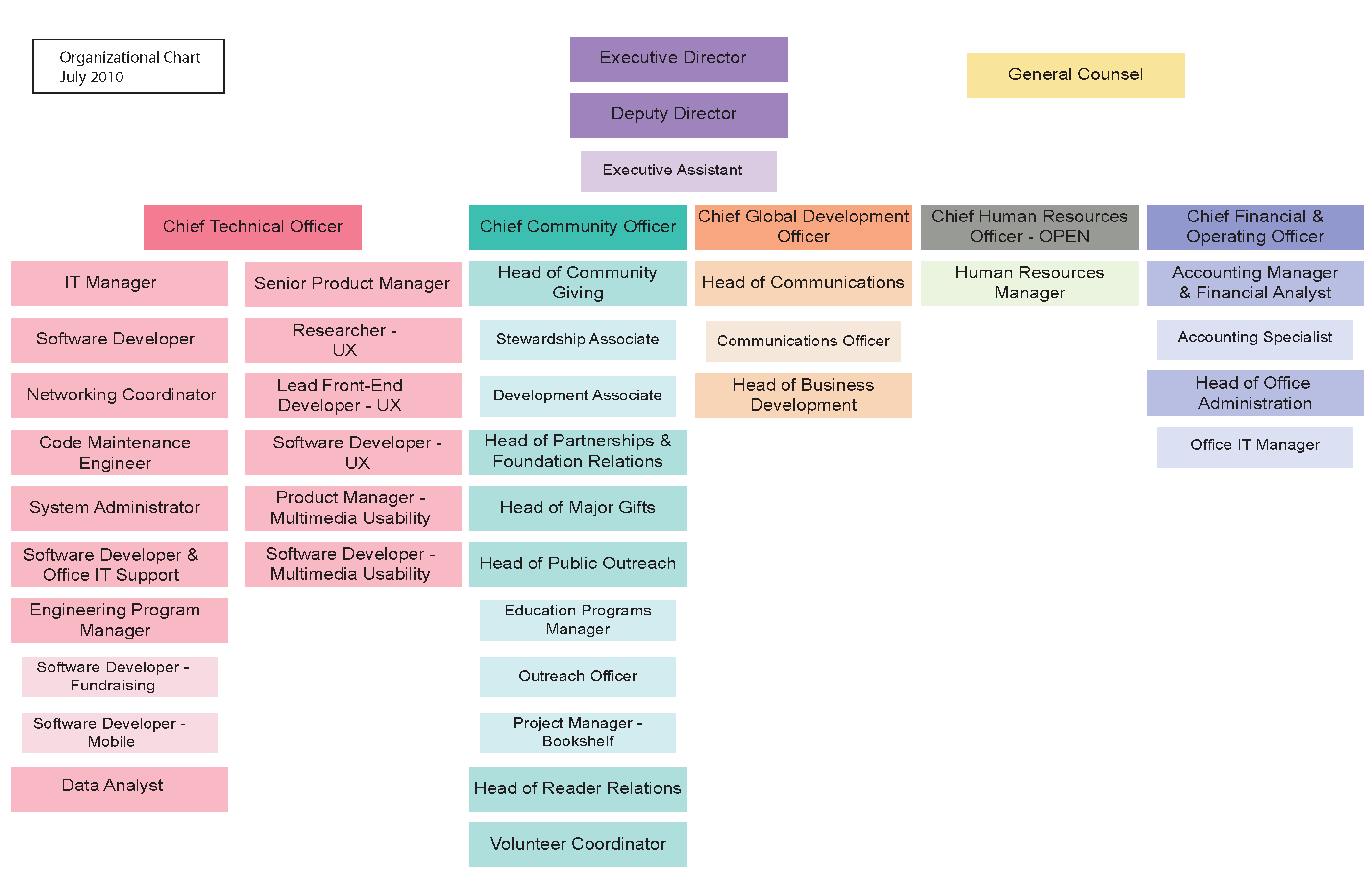
Wikimedia Foundation organization chart

File:EnglishWikipediaArticleCountGraph linear.png

Design a site like this with WordPress.com
Get started